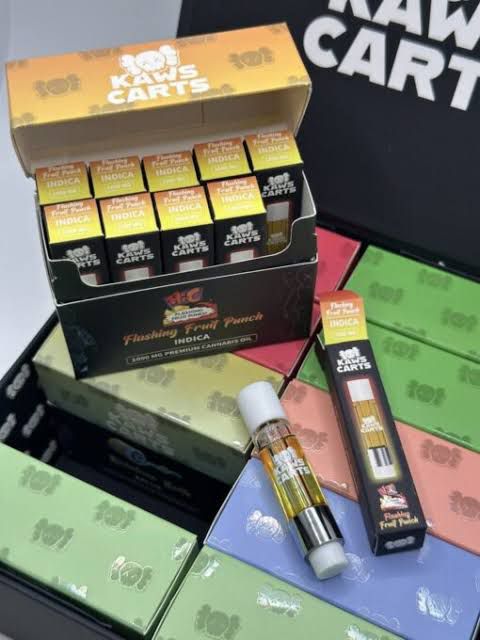
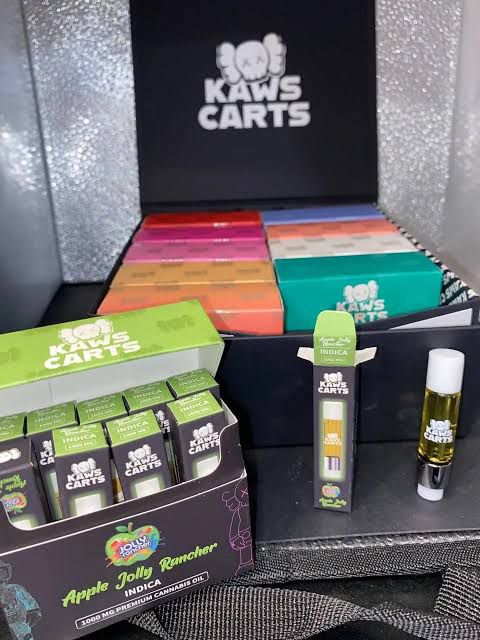
kaws carts
$20.00
Kaws carts occupy a striking but risky space in the THC vape world. They combine aggressive potency claims, flashy designer‑style branding, and a wide range of strain and dessert flavors into a product that many black‑market users find strong and enjoyable
Did you like this product? Add to favorites now and follow the product.
Description
Kaws Carts: Complete Guide to Strength, Flavors, Effects, Safety, and Real vs Fake
Kaws carts (also written as KAWS carts, Kaws Bars carts, or Kaws vapes) are THC vape cartridges and disposables sold under branding inspired by the street‑art and designer toy aesthetic associated with the name “KAWS.” They are promoted as premium, high‑potency 1 g cartridges filled with strong cannabis distillate and packed in colorful, collectible packaging that stands out from generic pens. Sellers frequently frame them as “exotic” or “designer” carts aimed at users who want both a hard‑hitting high and a stylish product to show off.
In product descriptions, Kaws carts are usually advertised as containing around 1000 mg of oil with THC levels often claimed in the 85–90% range. The oil is described as pure cannabis distillate, sometimes with full‑spectrum elements, blended with strain specific terpenes for flavor. Strain names like OG Kush, Cereal Milk, Nerdz, Kush Mints, and other popular genetics appear across different Kaws product lists. Alongside cartridges, Kaws Bars (disposable vapes) and other products like pre‑rolls and moonrocks are often sold under the same branding umbrella.
However, Kaws carts operate largely outside clearly regulated, state‑legal cannabis systems. They are commonly sold via direct‑shipping websites and through plugs rather than through licensed dispensaries tied to a specific state. That makes them best understood as black‑market or semi‑regulated products with strong marketing and variable actual oversight. This guide explains Kaws carts in that context: what they claim to offer, how they’re supposed to work, what the risks are, and how to evaluate them compared to licensed cartridges.
Kaws Carts Review
Kaws carts are marketed as premium cartridges built with modern hardware and filled with high‑potency distillate. The cartridges themselves are typically described as:
-
1 g (1000 mg) capacity.
-
Borosilicate glass or clear tanks so users can see the oil level.
-
Ceramic or “advanced” heating elements designed for even, efficient vaporization.
-
Standard 510 threading compatible with common pen batteries.
-
Mouthpieces shaped for comfort and good airflow.
The oil inside is promoted as:
-
High‑THC cannabis distillate, often claimed in the 85–90% THC range.
-
Sourced from “organically grown,” “top‑tier” cannabis strains.
-
Infused with terpenes that reflect specific strains and flavor profiles.
-
Free from certain banned additives like vitamin E acetate.
When these carts perform as advertised, users describe a vaping experience that feels:
-
Strong and fast‑acting, with noticeable effects after just a couple of hits.
-
Smooth on the throat when used at proper voltage, without immediate burnt taste.
-
Flavorful, with sweet, dessert‑like, or strain‑accurate notes depending on the cartridge.
Kaws Bars, the disposable versions, share a similar positioning: sleek design, strong distillate, and convenient all‑in‑one form factor. In word‑of‑mouth discussions, some users consider Kaws Bars among the better‑tasting and stronger black‑market vapes they have tried, especially when compared to very cheap, generic disposables.
At the same time, the lack of a clear, state‑licensed manufacturing base means that “Kaws” can describe everything from reasonably well‑made underground carts to poorly filled, low‑quality copies. The experience can range from genuinely potent and flavorful to weak, harsh, or inconsistent, depending entirely on who actually filled the cartridge and what oil they used.
kaws carts Price and Where to Buy
Kaws carts are positioned as premium “exotic” products rather than budget options. In many menus and wholesale listings, they are:
-
Sold individually at prices comparable to other high‑potency exotic or designer‑style carts.
-
Offered in bulk to resellers or “dispensaries,” often in wholesale quantities of 100 or more cartridges.
-
Marketed as giving “premium quality” and “unmatched consistency” to justify their price.
People typically encounter Kaws carts in four ways:
-
Direct‑shipping websites that present themselves as “official” Kaws stores and offer a range of products like carts, bars, moonrocks, and pre‑rolls, with delivery across many regions.
-
Exotic vape shops (online and in person) that specialize in designer‑branded carts and disposables, where Kaws appears alongside other recognizable street names.
-
Generic wholesale cartridge sites selling Kaws‑branded glass cartridges and packaging to anyone, often intended to be filled by local processors.
-
Through plugs and informal sellers who stock Kaws Bars and carts as part of a rotating menu of exotic vapes.
In strictly regulated states, you won’t typically see Kaws carts listed on official dispensary menus or tied directly into state tracking systems. This disconnect between premium marketing and unofficial distribution is a key part of understanding what Kaws carts really are: high‑profile black‑market/exotic products rather than clearly licensed, trackable cartridges.
Benefits and Use‑Cases of Kaws Carts
From the perspective of users who do choose Kaws carts, the perceived benefits center on potency, flavor, convenience, and style:
-
High potency: Kaws carts are advertised as very strong, often with THC contents above 85%. For users with established tolerance, that means fewer hits are needed to achieve a desired effect.
-
Flavor‑heavy experience: Strain‑inspired and dessert‑style terpene profiles make sessions feel more enjoyable than with harsh or bland carts. Sweet, fruity, and creamy flavors are common.
-
Convenience: Prefilled 1 g cartridges and disposables are simple to use—no grinding, rolling, or loading required. Attach to a battery or draw on a Kaws Bar and you’re ready to go.
-
Aesthetic appeal: The branding and packaging are designed to stand out, often mimicking or referencing the visual style of KAWS artwork and collectible culture. Some users enjoy the novelty and “flex” factor.
Typical use‑cases include:
-
Evening relaxation: Indica or hybrid Kaws carts, such as those based on Kush‑type strains, are used to wind down, reduce stress, and help with sleep.
-
Daytime/social use (experienced users only): Sativa or balanced strains like Cereal Milk or Nerdz are used for mood elevation, music, gaming, or social activities, as long as the user can function while high.
-
On‑the‑go sessions: Kaws Bars or carts pair with small batteries, making them easy to take to events or use discreetly.
-
Black‑market “connoisseurship”: In areas without strong legal markets, some users seek out Kaws as one of the “better” exotic brands, largely based on word of mouth.
Because potency is high and regulation is light or absent, these benefits come with trade‑offs. Many of the advantages are real (strong, tasty hits), but they have to be weighed against risk factors like unverified oil, unknown lab practices, and inconsistent quality control.
kaws carts THC Content and Potency
Potency is one of the biggest selling points of Kaws carts. Promotional copy repeatedly emphasizes:
-
THC percentages commonly in the mid‑80s to around 90%.
-
Full‑gram (1000 mg) cartridges packed entirely with distillate and terpenes, not half‑grams or heavily diluted oil.
-
Effects described as “powerful,” “long‑lasting,” and suitable even for experienced users.
Practically, this means that if the claims are anywhere close to accurate:
-
A small number of hits can produce intense effects. Users with moderate tolerance may feel substantial psychoactive effects from just one or two medium pulls.
-
Heavy users can still feel well‑satisfied, especially if hits are spaced out and taken on a fresh cart.
-
For low‑tolerance users or those new to vapes, Kaws carts can easily be too strong, leading to anxiety, racing heart, and other unpleasant sensations if they overconsume.
It’s also important to consider that these are black‑market products. THC percentages on packaging may not correspond exactly to independent lab data, and different batches may vary widely in actual strength. One batch of Kaws carts might hit incredibly hard; another might be noticeably weaker, even if the label claims the same numbers.
With that in mind, dosing recommendations for Kaws carts should be conservative:
-
Start with one very small puff and wait at least 15–30 minutes to judge the effects.
-
If you want to increase intensity, take another small puff rather than a long, deep pull.
-
Avoid stacking multiple large hits in quick succession, especially if it’s a new batch or you don’t know the source well.
Because real lab verification is hard to access, your tolerance and immediate bodily feedback become your most reliable gauge of potency.
kaws carts Flavors and Strain Profiles
Kaws carts lean heavily into a combination of strain‑specific and dessert‑style flavor profiles. Across various menus and product lists, you can find Kaws cartridges offered in:
-
Classic strains: such as OG Kush, which tends to have earthy, piney, and gassy notes alongside a relaxing, heavy high.
-
Modern dessert strains: like Cereal Milk, which is often associated with creamy, sweet, and slightly fruity flavors.
-
Candy‑style strains: like Nerdz and similar hybrids, with bright, sugary, and fruity terpene blends.
-
Minty/gassy strains: such as Kush Mints, which combine the gas of classic Kush genetics with a cool, minty finish.
Marketing language commonly highlights:
-
Carefully selected terpenes designed to mirror the aroma and flavor of actual cannabis strains.
-
Distinct profiles for sativa, indica, and hybrid offerings, so users can choose based on desired effects.
-
Flavor that stays consistent through the life of the cartridge when used at proper temperature.
In user anecdotes, Kaws Bars and carts are often praised for their taste relative to other underground brands, especially when they are fresh and not overheated. Sweet flavors and strong aromas are part of the appeal.
However, because the production is not tied into a regulated system, nothing prevents a filler from using cheap artificial flavorings instead of high‑quality terpenes. As a result:
-
Some Kaws carts may taste rich and strain‑accurate.
-
Others might taste overly chemical, synthetic, or perfume‑like.
-
Flavor quality depends entirely on the specific production source and batch, which the consumer often cannot verify.
When you do use Kaws carts, pay close attention to how natural or artificial the flavor feels, and be cautious if it tastes like raw chemicals or burns at low temperature.
kaws carts Pros and Cons of Kaws Carts
Pros
-
High claimed potency: Kaws carts are marketed as very strong, making them attractive to experienced users who want intense effects.
-
Flavor variety: A menu of popular strains and dessert profiles offers many taste options to suit different preferences.
-
Large capacity: 1 g carts and Kaws Bars disposables offer many sessions before running out.
-
Comfortable hardware (when genuine): Ceramic coils and glass tanks can provide smooth vapor and decent reliability.
-
Brand appeal: The Kaws name and artwork‑style branding appeal to fans of designer goods and exotic cannabis products.
Cons
-
Unclear licensing: Kaws carts operate outside clearly licensed state markets, making their regulatory status uncertain.
-
Difficult authentication: Kaws‑branded hardware and packaging can be purchased and filled by anyone, so authenticity is almost impossible for consumers to verify.
-
Testing claims not independently backed: Lab testing is described in brand copy, but results are not easily tied to state‑mandated systems or independent databases.
-
Safety risk inherent to black‑market vapes: As with any unregulated cart, there is a risk of contamination, cutting agents, or mislabeled potency.
-
Very high strength can be overwhelming: Without careful dosing, users—especially new ones—can easily consume too much and experience unpleasant side effects.
For a risk‑aware user, these pros and cons translate to a clear trade‑off: Kaws carts can be potent and tasty, but they do not offer the safety assurances of regulated dispensary cartridges.
How to Use Kaws Carts
If someone chooses to use Kaws carts, proper technique and caution can improve the experience and reduce some risks associated with high‑potency oil.
-
Select a suitable battery
-
Use a 510‑thread battery from a reputable manufacturer.
-
A device with variable voltage is ideal so you can fine‑tune settings.
-
-
Attach the cartridge
-
Carefully screw the Kaws cart onto the battery until it’s snug.
-
Do not overtighten; that can damage the contact point.
-
-
Set voltage low at first
-
Start with a low to medium voltage. High voltage can burn terpenes and produce harsh, potentially harmful vapor.
-
Many ceramic carts perform best on lower temperatures for both flavor and longevity.
-
-
Take a small test puff
-
Inhale gently for about one to two seconds.
-
Exhale and pay attention to both flavor and how your body feels.
-
-
Wait and evaluate
-
Give at least 15–30 minutes after that first puff to see how strong the effects become.
-
If you feel comfortable and want more, add another small puff rather than a large, deep hit.
-
-
Adjust slowly
-
If vapor production is minimal at low setting but you’re sure the cart is working, you can increase voltage slightly.
-
Keep sessions moderate to avoid overheating the oil or coil.
-
-
Store properly
-
Store the cart upright when possible to help oil stay in the tank.
-
Keep it away from high heat and direct sunlight, which can thin oil, cause leaks, and degrade flavor.
-
This approach helps you enjoy the flavor and potency of Kaws carts while minimizing harshness, clogs, and the risk of overconsumption.
Kaws Cart Not Working (Troubleshooting)
Like any cartridge, a Kaws cart can misbehave. Here are common issues and ways to troubleshoot them:
No vapor at all
-
Ensure the battery is fully charged and turned on.
-
Check that the cartridge is actually making contact with the battery; gently loosen and retighten.
-
Clean the contact points (both on the battery and cart base) with a dry cotton swab to remove oil.
-
Try the cart on a different battery to see if the problem is the device or the cart.
-
If the cart still doesn’t produce vapor and there is clearly oil remaining, the internal coil may be dead or defective.
Very weak hits
-
Slightly increase voltage if you started at the very lowest setting.
-
Take slower, slightly longer inhales, giving the coil time to vaporize the oil.
-
If the vapor remains weak despite adjustments, the oil may be low in potency or the cart may be partially clogged or poorly filled.
Clogged or tight airflow
-
Warm the cartridge gently in your hand or pocket for a few minutes. Thicker oil will flow better when slightly warmer.
-
Take a couple of primer puffs without fully inhaling, just enough to warm the coil and airway.
-
Avoid taking repeated large hits in rapid succession, which can contribute to condensation buildup.
-
Store upright when not in use to reduce oil pooling in the mouthpiece.
Harsh or burnt taste
-
Immediately lower the voltage setting. High power scorches oil and terpenes quickly.
-
Take shorter puffs and give the cart time to cool between hits.
-
If the cart tastes burnt from the first hit even at low voltage, the coil may be damaged or the oil may be degraded; continuing to use it is not advisable.
Leaking or oil in the mouth (spitback)
-
Wipe away any oil around the mouthpiece and base.
-
Avoid leaving the cart in hot environments, such as in a car or near radiators. Heat can thin oil and push it through seals.
-
Use gentler, shorter pulls to reduce pressure that might force oil into the airway.
If a Kaws cart behaves badly despite careful use and you cannot return it (which is common with informal purchases), the safest decision is to stop using it rather than trying to “vape through” the problem.
Kaws Carts: Real vs Fake (Authenticity)
Authenticity with Kaws carts is tricky because the brand itself is not clearly anchored to a single, widely recognized licensed cannabis company. Instead, the name, logo, and packaging appear across multiple websites and sellers, some claiming to be the official source. This creates a landscape where “real Kaws” and “fake Kaws” are both unregulated, with the main difference being whether the product came from a particular producer or from someone else reusing the same branding.
Key points to consider:
-
Packaging can be duplicated: Kaws‑branded boxes, stickers, and even printed glass cartridges are widely available for purchase. Anyone can fill them with whatever oil they have.
-
“Official” sites are self‑declared: Websites that call themselves official can be set up by the brand’s originator or by imitators; consumers have no regulator‑verified way to check.
-
QR codes and COAs can be spoofed: Even if a box has a QR code linking to a lab result, there is no guarantee that the result corresponds to that specific oil or that the lab itself is independent and reputable.
In this context, “real vs fake Kaws” is less about a strict line between licensed and counterfeit and more about:
-
Products coming from a relatively consistent manufacturer that invests in decent oil and hardware.
-
Products coming from opportunistic fillers using the Kaws aesthetic to sell whatever oil they can source cheaply.
For a typical user, the safest position is to assume that any Kaws cart is, at best, a black‑market product and, at worst, a completely unknown mixture. There is no reliable way for you to fully authenticate it the way you could with a true licensed dispensary brand.
Lab Tests, Safety, and Why Source Matters for Kaws Carts
Kaws marketing often mentions:
-
Third‑party lab testing for potency and purity.
-
Screening for pesticides, heavy metals, and other contaminants.
-
Production in “state‑of‑the‑art facilities” that follow quality standards.
If Kaws carts were integrated into a regulated state system, those would be strong points. But without that external framework, these claims are difficult for consumers to verify. There is no straightforward way to cross‑check a Kaws cart’s lab data against a state database or to confirm that every batch is tested in the same way.
From a safety perspective, this means:
-
Kaws carts share the general risks associated with black‑market THC vapes.
-
Even if some batches are clean, others might be cut with unknown agents, contain residual solvents, or include pesticides and heavy metals from poorly grown or processed material.
-
Users cannot rely on packaging alone to judge safety.
To manage these risks if someone still chooses to use Kaws carts:
-
Use them sparingly rather than as a daily or heavy‑use staple.
-
Pay attention to taste and physical sensations; harsh, chemical‑tasting vapor or chest tightness at low power are red flags.
-
Consider getting lung‑related symptoms evaluated by a medical professional if they arise after using any unregulated vape.
-
Whenever possible, shift toward cartridges sold through licensed dispensaries, where testing and traceability are enforceable by law.
In short, Kaws carts might be strong and tasty, but they do not offer the same safety assurances as regulated products.
Comparison Table: Kaws Carts vs Licensed and Generic Carts
| Feature | Kaws Carts | Licensed Dispensary Carts | Generic Black‑Market Carts |
|---|---|---|---|
| THC potency (claimed) | Often 85–90% THC, 1 g carts | Usually 70–90% THC, clearly labeled | Unknown, often exaggerated |
| Oil type | Distillate with strain/dessert terpenes | Distillate, live resin, or rosin, traceable | Distillate of unknown origin |
| Testing | Brand‑claimed third‑party tests | State‑mandated testing with track‑and‑trace | Rarely tested |
| Hardware | Glass + ceramic, exotic branding | Varies, but vetted by licensed operators | Varies, often cheap |
| Distribution | Direct shipping, plugs, exotic shops | Licensed dispensaries and legal delivery | Street sellers and unverified sites |
| Regulatory oversight | Very limited or none | Strong, enforced by state agencies | None |
| Ideal user | Risk‑aware user seeking strong, exotic carts | Safety‑focused, medical or legal‑market user | Uninformed or price‑driven user |
This comparison highlights that Kaws sits closer to the black‑market side, even if its branding and oil are better than completely generic street carts.
Consumer Feedback on Kaws Carts
Consumer feedback on Kaws carts and Kaws Bars splits into two broad camps: those who focus on effects and flavor, and those who prioritize regulation and safety.
Among users who try them and share anecdotal reviews:
-
Many report that Kaws Bars and carts hit hard and can be some of the strongest black‑market vapes available in their area.
-
Flavor is often described as very good for a street cart, with sweet, strain‑inspired tastes that are easy to enjoy.
-
Some appreciate the unique packaging and find the overall experience satisfying, especially compared to cheaper anonymous disposables.
Among safety‑minded users and people involved in discussions about fake carts:
-
There is strong skepticism toward any brand that exists primarily through online shipping and plug distribution without visible licensing.
-
Kaws‑style branding is seen as part of a broader trend of unlicensed exotic carts that may look professional but are not regulated.
-
The recommendation is often to avoid such brands entirely if legal, tested alternatives are available.
In essence, fans of Kaws carts speak highly of the experience, while critics focus on the structural risks that come from using any black‑market vape brand.
Frequently Asked Questions About Kaws Carts
Are Kaws carts legit?
Kaws carts are legit in the sense that they exist and many people use them, but they are not clearly part of a mainstream, regulated cannabis brand. They should be treated as black‑market or semi‑regulated products, not as licensed dispensary cartridges.
How strong are Kaws carts?
They are marketed as very strong, often claiming THC percentages around 85–90%. Many users report that they hit hard, but actual strength can vary by batch and filler.
Are Kaws carts safe?
There is no guaranteed answer. Some batches may be relatively clean; others could be contaminated or cut. Because they are not tied into a regulated system, Kaws carts carry more safety risk than licensed dispensary products.
Why do people like Kaws Bars and carts?
People like them for their strong effects, sweet and strain‑inspired flavors, large 1 g capacity, and visually appealing packaging. They are also popular as “exotic” items in underground markets.
Can Kaws carts be fake?
Yes. Kaws packaging and even printed glass cartridges can be purchased and filled by anyone. There is no reliable way for consumers to know who actually made the oil inside a given cart.
Are Kaws carts good for beginners?
Because of their high claimed potency and lack of oversight, Kaws carts are not ideal for beginners. New users who nevertheless try them should start with extremely small puffs and wait a long time between hits.
What’s the difference between Kaws carts and licensed carts?
Licensed carts are produced under state regulations, tested by accredited labs, and sold through legal dispensaries with track‑and‑trace systems. Kaws carts are sold via direct‑shipping sites and informal sellers, with testing and quality controlled only by the brand and its partners, not by regulators.
Conclusion
Kaws carts occupy a striking but risky space in the THC vape world. They combine aggressive potency claims, flashy designer‑style branding, and a wide range of strain and dessert flavors into a product that many black‑market users find strong and enjoyable. When filled with decent distillate and terpenes, a Kaws cart can provide a powerful, flavorful high in a convenient 1 g format.
However, they also illustrate the core problem with unregulated exotic carts: no clear licensing, no transparent oversight, and an easy path for anyone to copy packaging and fill it with unknown oil. For users, this means Kaws carts should be approached with respect and caution—if at all. If someone chooses to use them, careful dosing, proper battery use, and vigilant attention to taste and physical reactions are essential. For long‑term, frequent, or medical use, shifting toward fully licensed, lab‑verified cartridges is a safer path than relying on any black‑market brand, no matter how strong or stylish it seems.
Additional information
| FLAVORS | 24K, CEREAL MILK, CHERRY LIME, GELATO, GORILA GLUE, JET FUEL, KUSH MINT, MIMOSA, OG KUSH |
|---|
Related products

Recently Viewed Products


Reviews
There are no reviews yet.